all-projects2026
PROJECT_003 · Security tooling
Cerberus vulnerability assessment
A Python framework that chains reconnaissance, multi-threaded port scanning, service fingerprinting, live CVE lookups against the NIST NVD and web-application checks, driven from a CLI or a web GUI, and ending in a scored PDF report.
haadi@portfolio:~$ eog results.png
haadi@portfolio:~$ cat project.yml
- technologies
- Python, Flask, Socket.IO, React, NIST NVD API, ReportLab, Rich
- role
- Solo: design & development
- year
- 2026
- status
- Complete
How it wasbuilt
haadi@portfolio:~$ cat -n the-problem.txt
- A basic assessment usually means stitching together separate tools, one for host discovery, one for ports, manual CVE research, another for web checks, and then writing the report by hand.
haadi@portfolio:~$ cat -n the-approach.txt
- I built Cerberus as a modular pipeline where each phase is its own package and hands structured results to the next. The same engine sits behind two interfaces: a rich terminal CLI with scan profiles, and a web GUI with live progress over WebSockets.
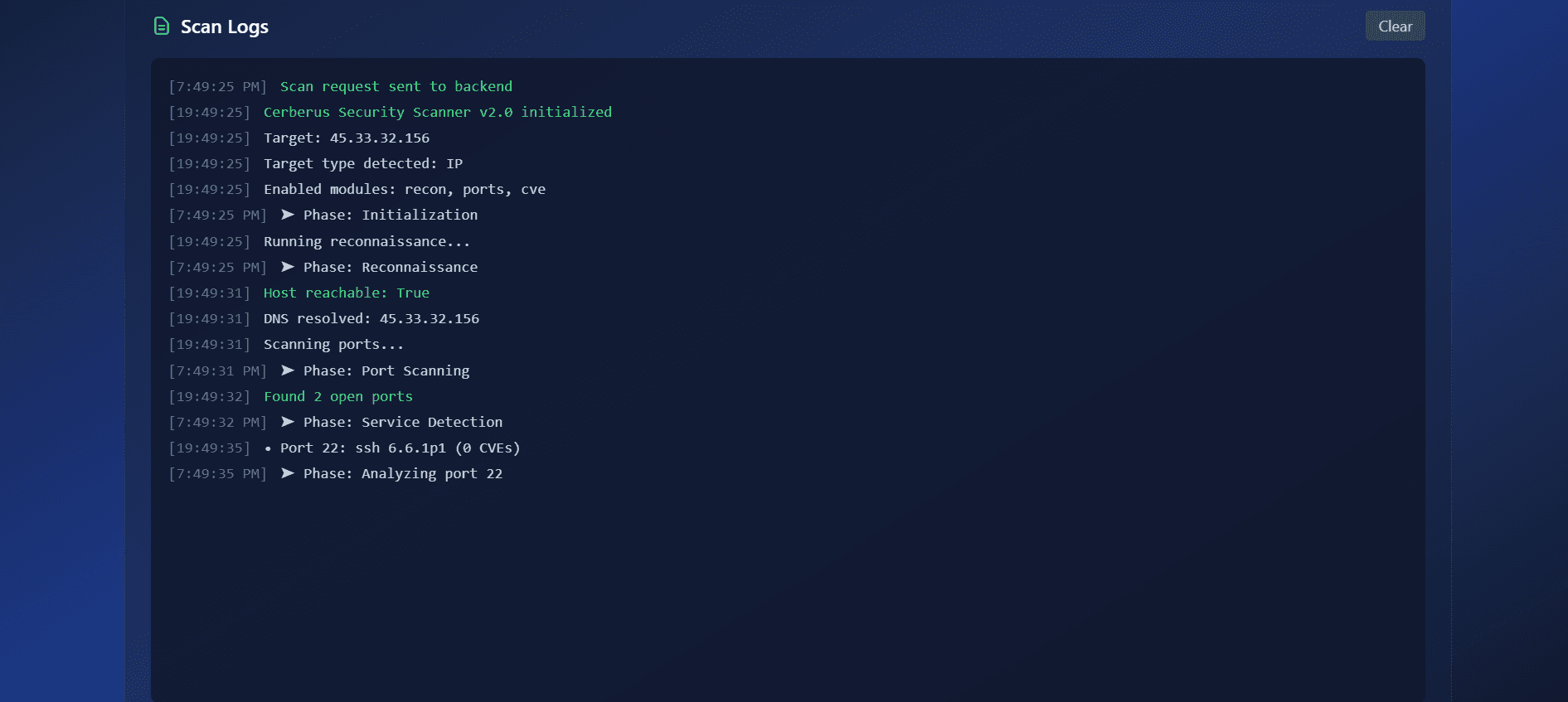
- recon: ICMP host discovery, forward and reverse DNS, TCP connectivity checks
- ports: multi-threaded TCP enumeration and banner-based service fingerprinting
- cve: automated NVD queries with semantic version comparison
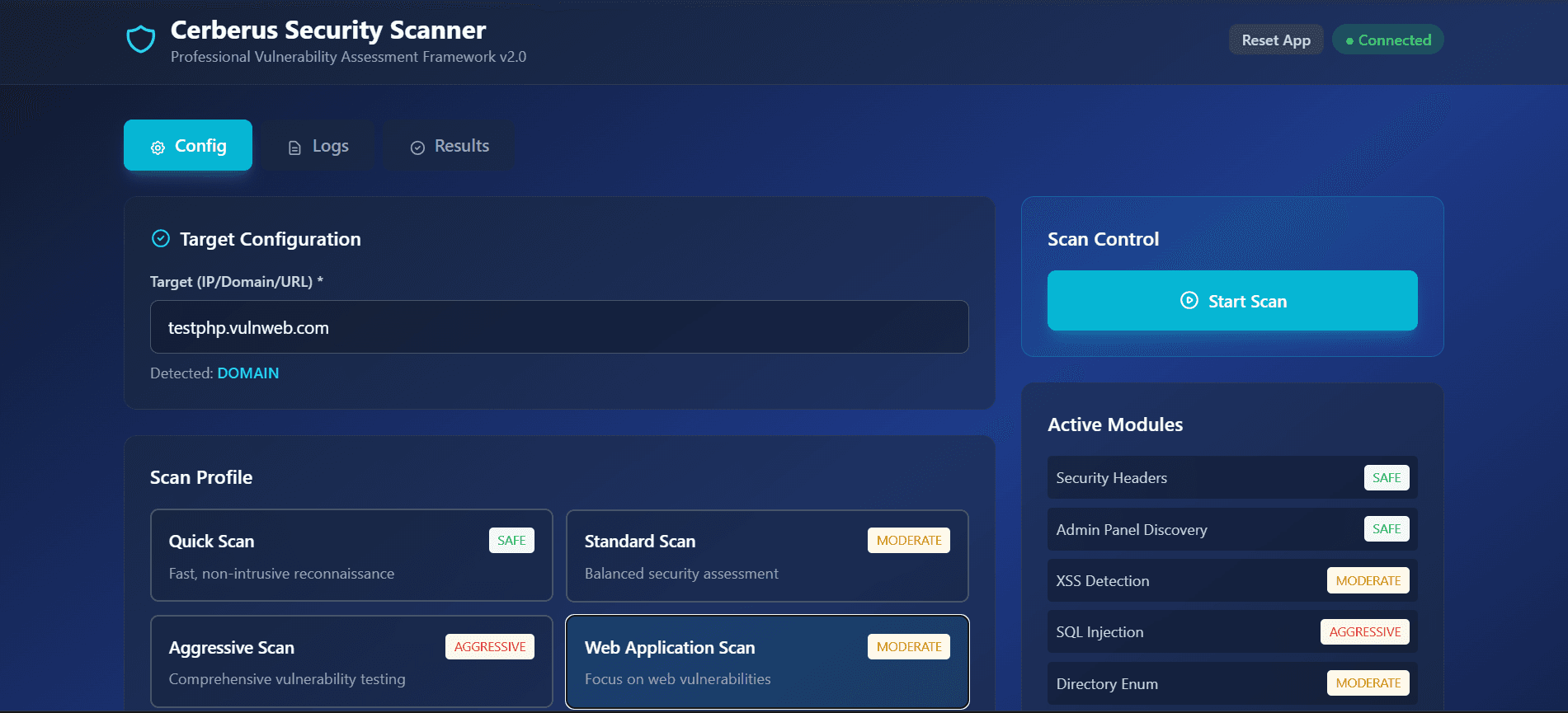
- web: security headers, admin panel discovery, XSS, SQLi and directory enumeration
- reporting: PDF assessment reports; JSON output; activity audit log
haadi@portfolio:~$ cat -n implementation.txt
- Port scanning runs across 50 worker threads. Detected service versions are matched against CVEs pulled in real time from the NVD, with the packaging library handling version comparison so ranges are evaluated correctly rather than by string match.
- The web module checks for CSP, HSTS, X-Frame-Options, X-XSS-Protection and Referrer-Policy, runs 20+ reflected-XSS payload variations, tests error- and boolean-based SQL injection, and brute-forces directories from a wordlist with rate limiting.
haadi@portfolio:~$ cat -n cli.txt
python main.py --target example.com --profile quick
python main.py --target 192.168.1.1
cd gui && python backendAPI.py   # web GUI on :5000
What itproved
haadi@portfolio:~$ cat -n security-details.txt
- Findings are classified Critical, High, Medium or Low and rolled into a 0 to 100 risk score. Scan profiles are labelled safe, moderate or aggressive so the operator knows how intrusive a run will be, and the tool includes built-in authorization checks and risk warnings.
- It was demonstrated only against public hosts that exist to be scanned (such as testphp.vulnweb.com and scanme.nmap.org), never against systems without permission.
haadi@portfolio:~$ cat -n result.txt
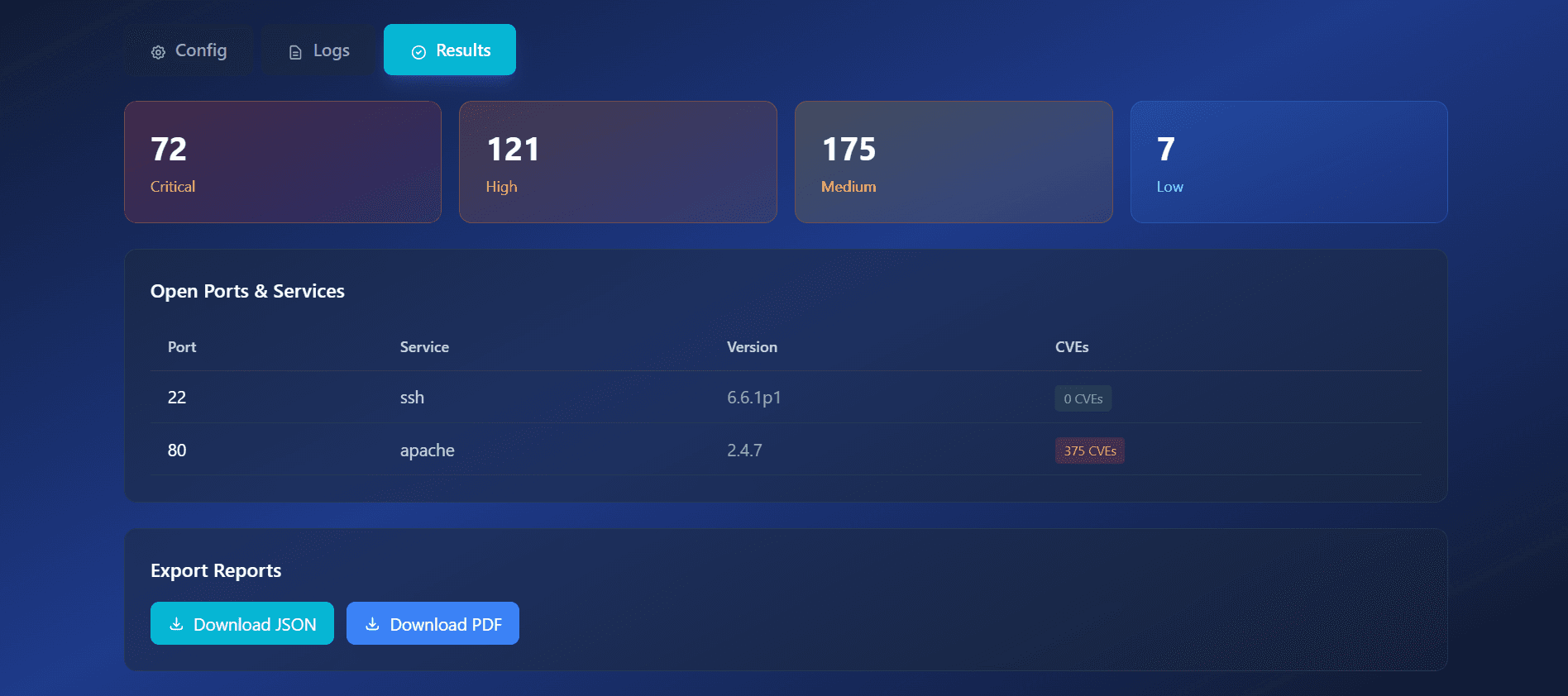
- A single command now produces what used to take several tools and an afternoon: an executive summary with a risk score, a vulnerability distribution chart, CVE detail with remediation steps and web findings with evidence.
- Concurrent scanning threads
- 50
- Concurrent scanning threads
- Reflected-XSS payload variations
- 20+
- Reflected-XSS payload variations
- CVEs matched to one outdated Apache on a test host
- 375
- CVEs matched to one outdated Apache on a test host
Evidence fromthe lab
haadi@portfolio:~$ eog config.png
haadi@portfolio:~$ eog logs.png
haadi@portfolio:~$ eog results.png
Stack &links
haadi@portfolio:~$ cat -n technologies-used.txt
pythonflasksocket.ioreactnist nvd apireportlabrich
haadi@portfolio:~$ cat -n links.txt
Next project